Wednesday, June 15, 2016

A new plasterer bee: Goniocolletes wanni

Image from original publication
Plasterer bees or polyester bees smooth the walls of their nest cells with secretions applied through their mouthparts. These secretions dry into a cellophane-like lining. Over 50% of all bee species living in Australia belong to this family (Colletidae).

Not surprisingly the new species was found in Southern Australia. The species is named after Stan Wann, the grandfather of the co-collector, Beth Tully. Stan Wann grew up in the bush on the north coast of New South Wales, and had a profound knowledge of the birds and trees in the area.

For the experts: Goniocolletes comatus Maynard, 2013 is redescribed. G. wanni sp. n. and the male of Trichocolletes luteorufus Batley & Houston, 2012 are described.

Friday, June 10, 2016

A new anglerfish: Oneirodes amaokai

Deep sea anglerfishes are among the most bizarre-looking fish in the sea. There are about 200 species of anglerfish found throughout the world's oceans. The name of these fishes comes from the elongated dorsal spine that supports a light-producing organ known as a photophore. Through bioluminescence, this photophore can produce a blue-green light. The fish uses this appendage like a fishing lure, waving it back and forth to attract its prey (in case you didn't know that already - time to watch Finding Nemo). 

Our new species is one of three newly described species found in Indonesian waters. It was named after Dr. Kunio Amaoka, Professor Emeritus of Hokkaido University, to honour his contributions to ichthyology. 

For the experts: An examination of the ceratioid anglerfishes collected on the Indian Ocean side of Indonesia during surveys in 2004–2005 have revealed 18 species in 9 genera and 6 families, including three new species: Cryptopsaras couesii (Ceratiidae); Melanocetus johnsonii (Melanocetidae); Diceratias trilobus, Bufoceratias microcephalus sp. nov., B. thele, B. shaoi, B. cf. wedli (Diceratiidae); Himantolophus danae, H. sagamius, H. nigricornis, H. macroceratoides (Himantolophidae); Oneirodes quadrinema sp. nov., O. amaokai sp. nov., O. carlsbergi, O. cristatus, Dermatias platynogaster, Chaenophryne cf. melanorhabdus (Oneirodidae); and Linophryne parini (Linophrynidae). Of these, specimens of B. shaoi, H. macroceratoides, O. cristatus and L. parini represent the second records since the species were described. A specimen of H. nigricornis represents the third record and a specimen of Dermatias platynogaster represents the fourth record. Descriptive data and notes on the geographical distribution and morphological variation are provided for each species.

Wednesday, June 8, 2016

A new goby: Varicus lacerta

Photo by Barry Brown from original publication.
Marine biodiversity inhabiting shallow Caribbean coral reefs has been studied for more than 150 years, but much less is known about what lives at depths just below those accessible with conventional SCUBA gear. Thanks to the availability of a privately owned, manned submersible on the island of Curacao, the Curasub, scientists are able to intensively study depths to 300 m.

Researchers from the Smithsonian Institution have yet described another new goby fish from the region. Its name means lizard in Latin and refers to the reptilian appearance of the fish. It has a disproportionately large head and multiple rows of canine teeth in each of its jaws. For that reason the common name will be Godzilla goby.

For the experts: We describe a new species of goby, Varicus lacerta sp. n., which was collected from a mesophotic reef at Curacao, southern Caribbean. The new species is the tenth species of Varicus, all of which occur below traditional SCUBA depths in the wider Caribbean area. Its placement in the genus Varicus is supported by a molecular phylogenetic analysis of three nuclear genes and the mitochondrial gene cytochrome b. In addition, the new species has one anal-fin pterygiophore inserted anterior to the first haemal spine, which distinguishes Varicus species from most species in the closely related and morphologically similar genus Psilotris. Varicus lacerta sp. n. is distinguished from all other named species of Varicus by the absence of scales, having highly branched, feather-like pelvic-fin rays, and in its live coloration. We provide the cytochrome c oxidase I DNA barcode of the holotype and compare color patterns of all species of Varicus and Psilotris for which color photographs or illustrations are available. This study is one of several recent studies demonstrating the utility of manned submersibles in exploring the diversity of poorly studied but species-rich deep-reef habitats.

Tuesday, June 7, 2016

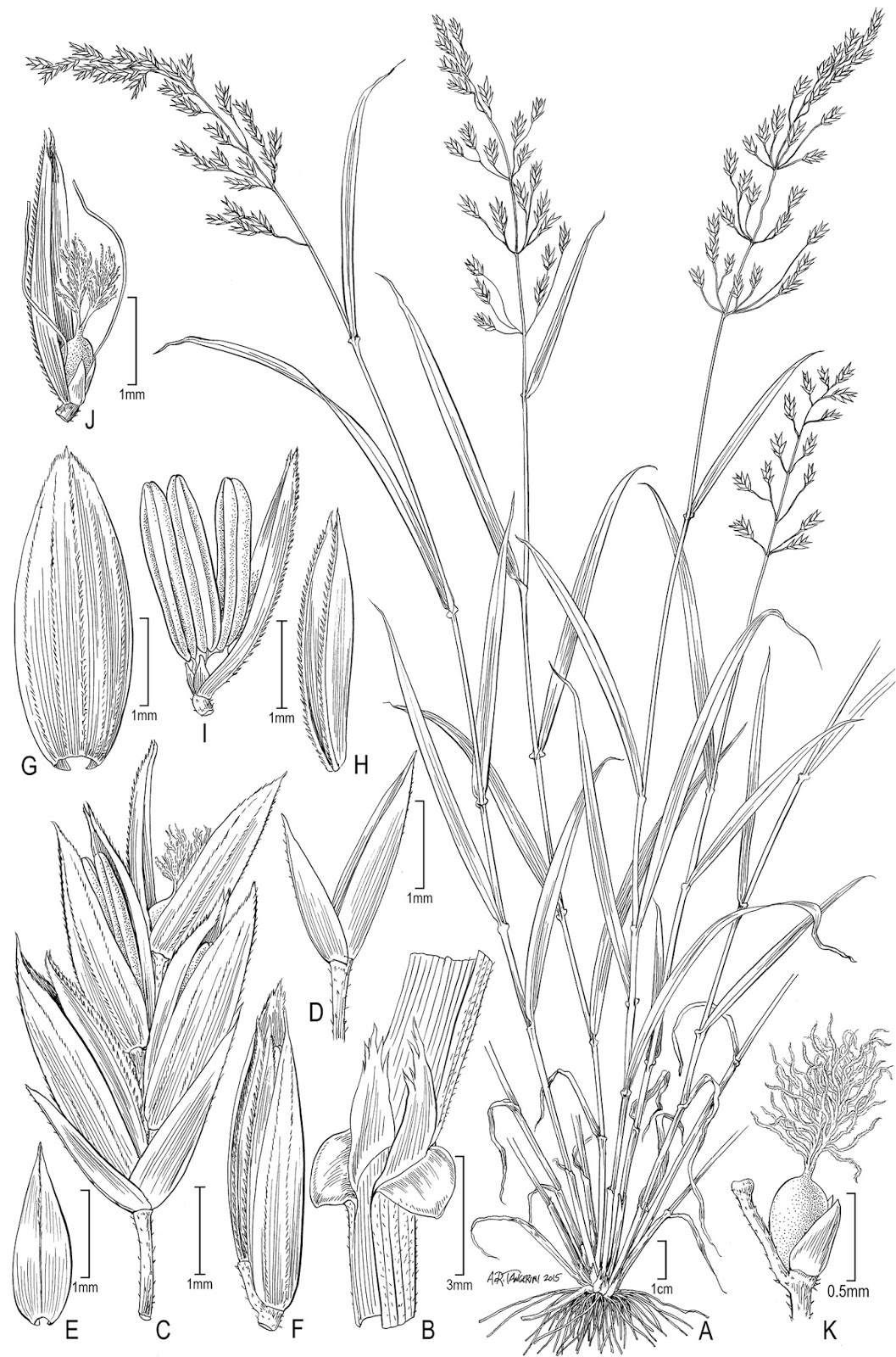
A new grass: Poa auriculata

Image from original publication
The Poaceae family of flowering plants known as grasses. The group contains the cereal grasses, bamboos and the grasses of natural grassland and cultivated lawns as well as pasture. The name is derived from the Greek word Poa which means fodder. With 12,000 species this family is one of the largest among the plants.

This new species was found on a dry cliff face in the Cordillera de los Andes, Peru near Chachapoyas at an altitude of 3100–3200 m. The species name refers to some triangular auricles that are found on the top of the sheaths, a feature that is unique among species of Poa.

For the experts: In this study the peculiar Andean grass genus Aphanelytrum, with two species, is reduced to Poa subsect. Aphanelytrum comb. & stat. nov. A third species, Festuca reclinata, is assigned to the subsection, which shows states transitional between a more typical Poa and Aphanelytrum. Poa subgen. Poa supersect. Homalopoa sect. Dioicopoa subsect. Aphanelytrum comb. & stat. nov. is characterized in having stooling perennials with decumbent to spreading culm bases that continuously branch and often root at low to mid-culm nodes, glabrous spikelets with long rachillas 1.2–4.2 mm long, short glumes less than ½ the length of the florets, and lemmas with bifid apexes that are mucronate to short-awned. We provide for the three species taxonomic discussions, morphological and anatomical descriptions, keys, illustrations, and a list of specimens. Also, we provide two new names, Poa hitchcockiana nom. nov. and Poa sanchez-vegae nom. nov., and one new combination, Poa reclinata comb. nov. A new species, Poa auriculata sp. nov. from Peru, not thought to be a member of P. subsect. Aphanelytrum, is presented. It is the first in the genus with prominent auricles. In addition, we place Poa apiculata in Poa subgen. Poa supersect. Homalopoa sect. Dioicopoa subsect. Tovarochloa comb. & stat. nov.

Monday, June 6, 2016

A new termite: Uncitermes almeriae

Termites live in colonies and divide labor among castes, produce overlapping generations, and take care of their young collectively. Although this way of live is very similar to some species of hymenoptera, termites are at best distant cousins, closer related to roaches. There are more than 2,900 living termite species worldwide.

In Ecuador, researchers found a new species of a genus that so far had only one species.The new species was named in honour of Almeri Fernandes Sousa, the senior author's mother.

For the experts: The Neotropical termite genus Uncitermes Rocha & Cancello, 2012 was known from a single species, U. teevani (Emerson, 1925). In this paper a new species, Uncitermes almeriae sp. n., is described and illustrated from worker and soldier castes, along with observations on the Uncitermes nest. A distribution map with the occurrences of both species is presented. The new species is distinguished from its congener by the presence of short bristles covering the head capsule and frontal tube.

Friday, June 3, 2016

A new gecko: Strophurus congoo

Image from original paper
Yes, I do indeed have an inordinate fondness for geckos, these little reptiles best known for their specialized toe pads that enable them to climb smooth and vertical surfaces, and even cross indoor ceilings with ease. It seems that colleagues discover more and more of them these days and also from the same regions.

Within two months we see the second description of a new species from Queensland, Australia. The new species was named in honour of Mr Tom Congoo, Bar-Barrum elder, and his family, who hold native title claim over the area where it was first discovered.

For our experts: A new species of diplodactylid gecko in the genus Strophurus Fitzinger, from north Queensland, Australia, is described herein as Strophurus congoo sp. nov. It is a small, pale grey to tan, unpatterned or faintly striped gecko, resembling the phasmid geckos in appearance, habitat and behaviour. However, within Strophurus it is not closely related to the phasmid geckos. It is distinguished from all other Strophurus by a combination of even scalation, dull colouration, small size and short tail length. It is only known to occur in a restricted area of the northern Great Dividing Range, within the Einasleigh Uplands bioregion, in a relatively infertile area of rolling, largely granitic hills, and is only known from spinifex (Triodia) hummock grasslands in open woodland.

Wednesday, June 1, 2016

A new tree: Polyceratocarpus askhambryan-iringae

The custard apple family Annonaceae consists of about 2500 mostly tropical species. Many species are valued for their large pulpy fruits, some are exploited for timber, and others are known as ornamentals. The family consists of trees, shrubs, and woody climbers found mainly in the tropics, although a few species extend into temperate regions.

Our new species from the genus Polyceratocarpus is endemic to the Udzungwa Mountains of Tanzania and was named by Askham Bryan College and Iringa International School as part of a rainforest education program.

For the experts: Polyceratocarpus askhambryan-iringae, an endemic tree species of Annonaceae from the Udzungwa Mountains of Tanzania, is described and illustrated. The new species is identified as a member of the genus Polyceratocarpus by the combination of staminate and bisexual flowers, axillary inflorescences, subequal outer and inner petals, and multi-seeded monocarps with pitted seeds. From P. scheffleri, with which it has previously been confused, it differs in the longer pedicels, smaller and thinner petals, shorter bracts, and by generally smaller, less curved monocarps that have a clear stipe and usually have fewer seeds. Because P. askhambryan-iringae has a restricted extent of occurrence, area of occupancy, and ongoing degradation of its forest habitat, we recommend classification of it as Endangered (EN) on the IUCN Red List.